Capital efficiency: the SaaS metrics investors actually check now
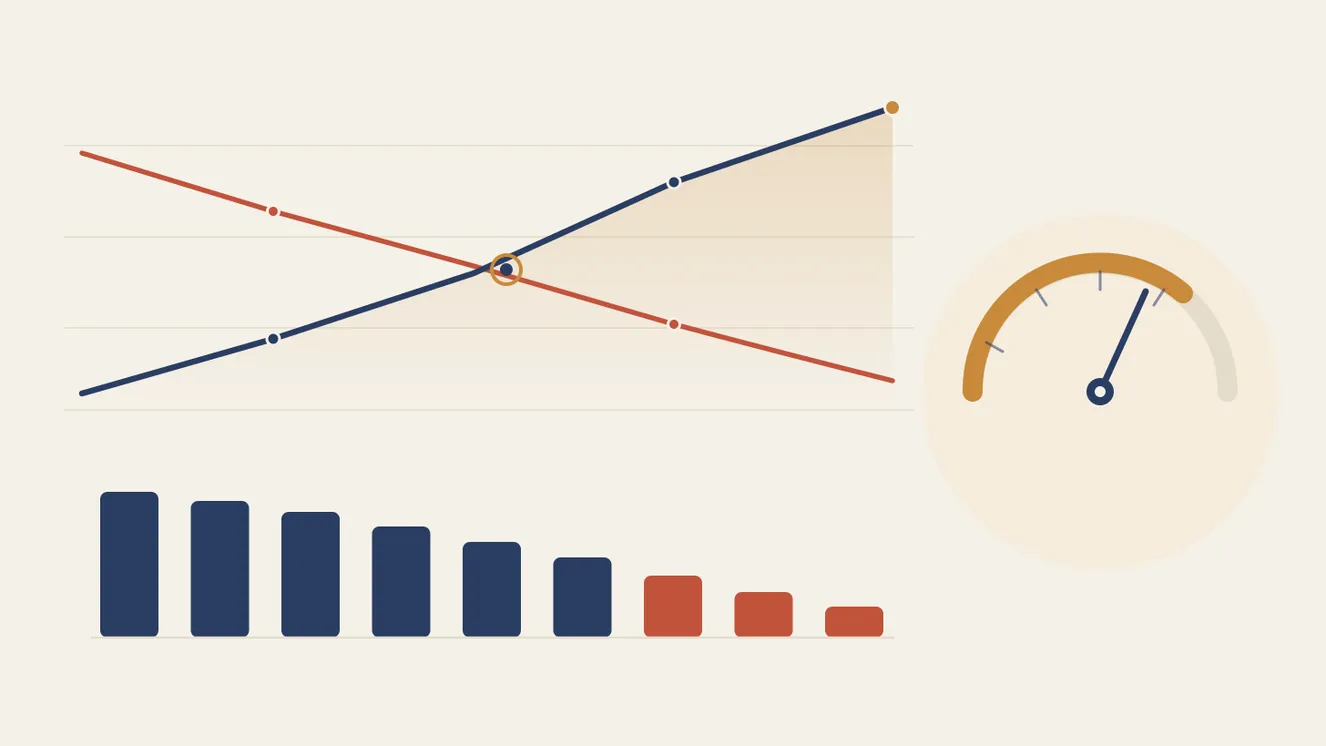
For most of the last decade, one number won funding rounds: growth. If you were doubling, nobody asked what it cost. Then 2022 reset the rules. Capital got expensive, multiples compressed, and the question every investor now opens with is not “how fast are you growing?” but “how much are you burning to do it?”
That shift has a vocabulary. A handful of efficiency metrics — runway, burn multiple, the magic number, CAC payback, and the Rule of 40 — have moved from finance-team footnotes to the first slide of a board deck. They all answer one question from different angles: is this growth worth its cost? Here is what each one measures, what good looks like, and which to watch at your stage.
The metric that comes first: runway
Before efficiency, survival. Runway is how many months of cash you have left at your current net burn — and it sets the clock on every other decision.
The maths is simple. Net burn is monthly expenses minus monthly revenue. Runway is cash divided by net burn. Six hundred thousand in the bank and fifty thousand of net burn a month is twelve months of runway. The trap is confusing gross burn (all cash going out) with net burn (what you lose after revenue). A company with high gross burn but strong revenue can have very little net burn — a far healthier place than the headline spend suggests.
The convention most founders follow: raise for 18 to 24 months, and start your next round with 6 to 9 months left. Fundraising takes longer than anyone plans for, and negotiating with under six months of cash is negotiating from weakness. Under six months is the danger zone, full stop.
There is a sharper version of the question, coined by Paul Graham: are you default alive? At your current growth and burn, would you reach profitability before the money runs out, without raising again? It reframes runway from a static balance into a trajectory. You can map yours with our burn rate and runway calculator.
Burn multiple: the headline efficiency number
If runway is survival, burn multiple is efficiency. Introduced by investor David Sacks in 2020, it divides net cash burned by net new ARR over the same period. In plain terms: how many dollars do you torch to add one dollar of recurring revenue?
It became an investor favourite because it captures the whole company in one ratio. Unlike CAC, which only looks at sales and marketing, burn multiple folds in product, engineering, overhead — every use of cash — against the recurring revenue it produced. Sacks’ original scale is the benchmark everyone still uses:
| Burn multiple | Verdict |
|---|---|
| Under 1x | Amazing — you add more ARR than you burn |
| 1x to 1.5x | Great |
| 1.5x to 2x | Good |
| 2x to 3x | Suspect |
| Above 3x | Bad — examine the model before spending more |
Lower is better, and the bar tightens as you scale. A seed company still finding product-market fit gets latitude to run high; by the time you are past 10M ARR, anything over 1.5x invites hard questions. The full definition, with a worked example, is in our burn multiple glossary entry.
The magic number: is your sales engine efficient?
Burn multiple judges the whole company. The magic number zooms in on one engine: go-to-market. It measures how much new annual recurring revenue each dollar of sales and marketing generates.
The formula pairs this quarter’s revenue gain with last quarter’s spend, because spend lags revenue — leads take time to close:
Magic number = (current-quarter revenue − prior-quarter revenue) × 4 ÷ prior-quarter sales and marketing spend
A result of 1.0 means a dollar of S&M returned a dollar of new ARR within a year. Read it as a traffic light:
- Below 0.5 — inefficient. The funnel is leaking; fix conversion, targeting, and retention before adding budget. More spend here just burns faster.
- 0.5 to 0.75 — acceptable but not efficient. Tighten before you scale.
- 0.75 to 1.0 — efficient. This is the green light to invest in growth.
- Above 1.0 — excellent, and sometimes a sign you are under-investing. You could likely spend more and stay efficient.
The discipline the magic number enforces is the most valuable thing about it: it stops you pouring money into a motion that does not yet work. Test yours with the SaaS magic number calculator, or read the full definition.
CAC payback and quick ratio: the supporting reads
Two older metrics round out the picture, and both have aged well into the efficiency era.
CAC payback period is how many months of gross-margin revenue it takes for a customer to repay what you spent acquiring them. It is a cash-flow metric, not a profitability one: two businesses with identical lifetime value can have wildly different cash needs depending on how fast customers pay back. Under 12 months is the healthy target for SMB SaaS; enterprise can justify 18 if retention is exceptional. Run yours through the CAC payback calculator.
The SaaS quick ratio measures growth efficiency from the revenue side: new plus expansion MRR divided by churned plus contraction MRR. A ratio of 4 means you add four dollars of new and expansion revenue for every dollar you lose. It is the fastest way to see whether you are growing on a solid base or filling a leaky bucket — two companies can post the same headline growth while one is far more efficient underneath.
The Rule of 40: the scoreboard at scale
The metric boards quote most is the Rule of 40: your revenue growth rate plus your profit margin should add up to at least 40. Grow 35% at a 10% margin and you score 45 — a pass. It works because growth and margin trade off, and the rule says the sum should hold whichever mode you are in.
The catch is that it only works at scale. Below roughly 10M ARR, growth swings too hard from quarter to quarter for the score to mean anything — which is exactly why early-stage founders should lean on burn multiple and the magic number instead. And the score is meaningless until you state which margin you used: far more companies pass on a free-cash-flow basis than on EBITDA. We unpack all of this, with 2026 pass rates and the valuation premium, in the full Rule of 40 guide, and you can check your score with the Rule of 40 calculator.
Which metric matters at which stage
You do not track all of these with equal weight at once. The right dial depends on your stage:
| Stage | Watch most | Why |
|---|---|---|
| Pre-seed / Seed | Runway, magic number | Survival and whether the go-to-market motion works at all |
| Series A | Burn multiple, CAC payback | Proof that growth is bought efficiently and pays back |
| Series B+ | Burn multiple, quick ratio | Efficiency at scale, with a clean revenue base |
| Growth / pre-exit | Rule of 40, NRR | The scoreboard buyers and public markets price on |
The thread running through all of them: efficient growth compounds, and inefficient growth just compounds the burn. Pair any efficiency metric with strong net revenue retention and you have the combination that earns premium multiples — growth that is both cheap to produce and sticky once you have it.
Track it live, not quarterly
Every metric here is built from the same raw material: your revenue movements and your cash. The problem is that most teams rebuild them in a spreadsheet the week before a board meeting, by which point a burn problem is a quarter old.
They do not have to be quarterly. Net new ARR, growth rate, and churn all move continuously off your billing data, so the metrics built on them can move continuously too. Mowt reads your Stripe data in real time and turns it into live MRR and ARR, so the growth half of every efficiency ratio is always current. You catch a slowing magic number or a creeping burn multiple the quarter it starts — not the quarter after an investor points it out.
FAQ
What is the most important capital efficiency metric?
There is no single answer — it depends on stage. Early on, runway and the magic number matter most, because they tell you whether you will survive and whether your go-to-market works. At scale, burn multiple and the Rule of 40 take over as the numbers investors and buyers price on. The common thread is that all of them test whether growth is worth its cost.
What is a good burn multiple?
Under 1x is elite — you add more ARR than you burn. Between 1x and 2x is healthy for most growth-stage companies, and anything above 3x is a warning sign. Seed-stage companies get more latitude while finding product-market fit, but by the time you are at scale, under 1.5x is the expectation.
How is the magic number different from burn multiple?
The magic number measures only sales and marketing efficiency — how much new ARR your go-to-market spend produces. Burn multiple measures all cash burned, including product and overhead, against new ARR. Use the magic number to judge your sales engine and burn multiple to judge the whole company.
How much runway should I keep?
The common rule of thumb is to raise for 18 to 24 months and start your next round with 6 to 9 months of cash left, because fundraising takes time and you never want to negotiate from desperation. Under six months of runway is a danger zone that demands you cut burn, accelerate revenue, or close a round quickly.
When should I start using the Rule of 40?
Around Series B or C, once you are past roughly 10M ARR and growth has started to decelerate. Below that, growth is too volatile for the score to be meaningful, and you are better judged on burn multiple and the magic number. The Rule of 40 becomes the headline scoreboard as you approach the scale where public-market comparisons and exits come into view.
About the Author

Matt Smith
Serial entrepreneur and former big 4 consultant turned SaaS operator. Built and scaled analytics and data warehouses platforms at multiple enterprise Stripe companies before founding Mowt. Passionate about making complex metrics accessible to every founder.